Estimated reading time: 6 minutes
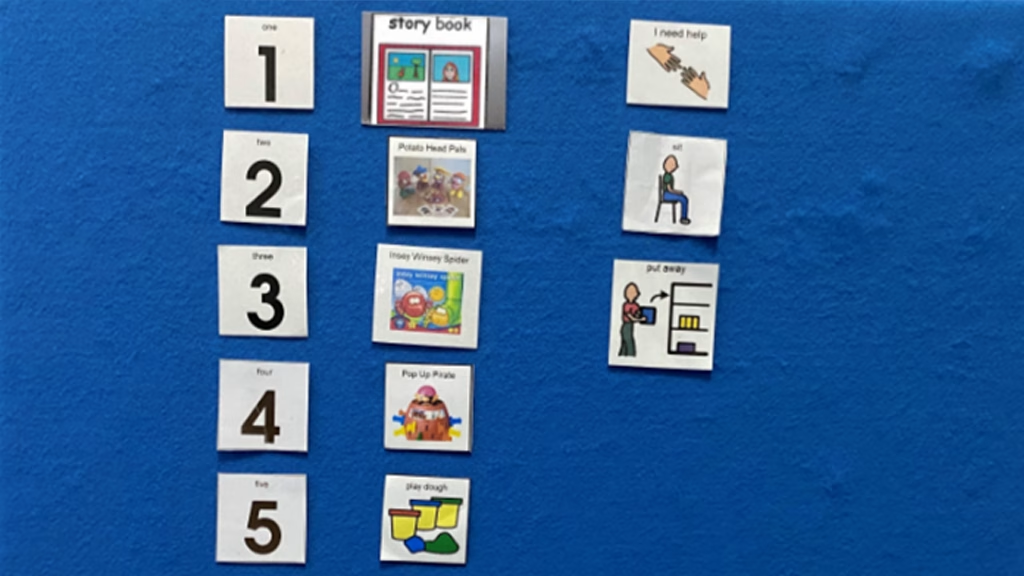
Visual schedules for children use pictures, symbols, words or photographs to show what will happen and in what order. They can help children understand routines, follow steps in everyday activities and prepare for transitions or changes.
Some children find spoken instructions difficult to process or remember, particularly when several steps are given at once. A visual schedule provides information that remains available for the child to look at, rather than relying only on spoken language. Visuals can be used at home, school, preschool or in the community and can be adapted to suit the child’s communication and learning needs.
How can visual schedules help children?
Visual schedules can make everyday routines and instructions easier to understand by presenting information in a clear and predictable way.
Spoken instructions can disappear quickly once they are said. A visual schedule remains available for the child to look at again, which can reduce the amount of information they need to hold in mind at one time.
Visual schedules may help children:
- understand the order of activities
- follow multi-step routines
- prepare for transitions or changes
- understand what is expected during an activity
- complete familiar routines more independently
- reduce uncertainty by making upcoming activities more predictable
For example, a morning visual schedule might show get dressed → eat breakfast → brush teeth → pack school bag → leave for school. A child can refer back to the schedule as they move through each step.
Visual schedules are most useful when they match the child’s level of understanding. Some children may respond best to photographs, while others may use pictures, symbols or written words.
How can I use a visual schedule at home?
Start with one familiar routine that your child completes regularly, such as getting ready for school, brushing teeth, bedtime or packing a bag.
Break the routine into a small number of clear steps. Use photographs, pictures, symbols or written words that your child can understand. Keep the wording simple and consistent.
Show the schedule before the activity begins and refer back to it as each step is completed. You can point to the next step, remove or tick off completed items, or move a marker along the schedule.
Try to use the schedule consistently so your child becomes familiar with how it works. As the routine becomes more familiar, you can gradually reduce prompts where appropriate while still keeping the visual available.
If the routine changes, update the schedule so it continues to match what will actually happen. Visual supports are most helpful when they are accurate, predictable and easy for the child to access.
Keep the schedule simple. Too many pictures or steps at once can make it harder to use, particularly when the routine is new.
Tip: Start small. A short three- or four-step schedule is often easier to learn than a long schedule covering the whole day.

What types of visual schedules can I use?
Visual schedules can take different forms depending on the child, the activity and the setting. The best option is usually the one that is easy for the child to understand and practical for adults to use consistently.
Common types of visual schedules include:
- Photograph schedules — use real photos of people, places, objects or activities.
- Picture or symbol schedules — use simple images or symbols to represent each step.
- Written schedules — use words or short phrases for children who can read and understand written instructions.
- First-then boards — show what will happen first and what will happen next.
- Checklist schedules — allow the child to tick off or mark each step as it is completed.
Some children may benefit from combining different formats. For example, a schedule might use a photograph with a short written label underneath.
It is usually best to keep the visual style consistent within one routine so the child can quickly recognise how the schedule works.
How can Speech Pathology and Occupational Therapy help?
Some children may benefit from additional support to understand routines, follow instructions, manage transitions or use visual supports effectively in everyday life.
A Speech Pathologist can help when a child has difficulty understanding spoken language, following instructions or using communication during daily routines. Visual supports may be used alongside other strategies to make information clearer and easier to process.
An Occupational Therapist can help when routines are affected by factors such as sensory processing, attention, planning, organisation or participation in everyday activities. Visual schedules may be used to support routines such as getting dressed, preparing for school, completing self-care tasks or moving between activities.
At Innerlink Therapy, our Speech Pathologists and Occupational Therapists work collaboratively with children, families and other important people in the child’s life. Strategies can be tailored to the child’s strengths, needs and everyday environments.
If your child is finding everyday routines, instructions or transitions difficult, contact Innerlink Therapy to discuss whether Speech Pathology or Occupational Therapy may be appropriate.
Frequently Asked Questions
What is a visual schedule? A visual schedule uses pictures, symbols, photographs or written words to show what will happen and in what order. It can help children understand routines, follow steps and prepare for changes or transitions
Who can benefit from a visual schedule? Visual schedules can be useful for children who find spoken instructions, routines, transitions, planning or remembering several steps difficult. The format should match the child’s level of understanding and communication needs.
What is the difference between a visual schedule and a first-then board? A visual schedule usually shows several steps or activities in sequence. A first-then board is simpler and shows only what will happen first and what will happen next. First-then boards can be useful when a child is learning to use visual supports or needs a shorter sequence.
Should I use photos, pictures or words? Use the format your child understands most easily. Some children respond best to real photographs, while others may understand simple pictures, symbols or written words. You can also combine formats where helpful.
How many steps should a visual schedule have? Start with a small number of steps, particularly when the schedule is new. Three or four clear steps can be easier to learn than a long schedule. More steps can be added later if appropriate.
When should I seek professional support? You may consider speaking with a Speech Pathologist or Occupational Therapist if your child regularly has difficulty understanding instructions, completing routines, managing transitions or participating in everyday activities. A therapist can help identify strategies suited to your child’s needs.